
By Sam Cabral, Certified Strength and Conditioning Specialist (CSCS)
You are committing significant financial resources to local competitive sports, driving all over for weekend tournaments, and putting in endless hours. Yet despite that dedication, you or your youth athlete keep getting outpaced on the field. Even worse, that relentless volume of practices often leads to persistent joint discomfort instead of explosive athletic performance.
Drawing from my background as a national-level Field Hockey athlete, a Master of Exercise Sciences graduate, and a Certified Strength and Conditioning Specialist (CSCS), I see how disappointing it is when generic high-volume training fails to produce game-day speed.
Developing elite speed goes far beyond raw talent or running until exhaustion. Sprinting is a refined physical skill driven by biomechanics, ground-reaction forces, and targeted central nervous system adaptations.
Here is how we build faster, more resilient athletes at Lift Clinic.
TL;DR: The Speed Development Blueprint
- Build the Engine (Strength): Increasing your relative body strength allows you to apply massive amounts of force into the ground with every single step.
- Build the Springs (Plyometrics): Transform raw weight room strength into explosive field speed through targeted jump training and reducing your ground contact time.
- Build the Accelerator (Resisted Sprints): Utilize heavy resisted sprinting to dramatically improve your initial 0-10m acceleration phase.
Ready to get faster?
Book a Strength & Conditioning Consult with our coaching team today.
The Science of Speed: Myths vs. Reality
There is a massive difference between what standard commercial personal training looks like and true athletic speed development. Standard fitness programs often target general hypertrophy and measure success by how much you sweat.
But speed is a high-threshold central nervous system (CNS) skill. To increase sprint speed, we have to look at what the research and clinical data actually tell us.
Force Over Footwork
The biggest misconception in Vancouver Youth Athletics is that “quick feet” agility ladders make you faster. Rapid foot-tapping applies minimal force to the ground. Sprinting, however, requires massive vertical force applied in under 0.10 seconds. True speed comes from pushing the earth away with high ground-reaction forces, not light shuffling.
Sweat vs. Intent
A common pitfall in Vancouver youth athletics is mistaking general exhaustion for genuine performance gains. Once you are gasping for air and your muscles are heavy with fatigue, your technical sprint mechanics inevitably degrade. When movement quality suffers, you fail to hit the 95-100% velocity threshold required to drive the central nervous system adaptations that actually make an athlete faster.
Effective speed development requires prioritizing complete recovery between bouts, ensuring every repetition is executed with maximal intent and pristine quality.
The Speed Training Blueprint
Mechanics of Speed: Stride Length and Frequency
To get faster, we first need to understand what actually makes an athlete fast. At its foundation, elite speed development boils down to biomechanics and force application. Mastering proper joint angles and body positions is essential across every phase of sprinting, from initial acceleration to peak velocity.
At its core, sprinting velocity depends on two key biomechanical drivers: stride length and stride frequency. Athletes must either cover more distance per step or execute turnover more rapidly. Elite sprinters optimize both.
Acceleration Phase: Initial acceleration requires significant horizontal force application. To propel your body forward efficiently, foot contact must land directly beneath or behind the center of gravity. This movement pattern relies heavily on stride frequency and rapid rate of force development.
Max Velocity Phase: At peak speed, ground-force production shifts toward vertical stiffness. Preserving top-end velocity requires striking the ground directly under your hips. Pushing backward excessively compromises balance, while overstriding ahead creates disruptive deceleration forces. This demands an optimized stride length that maximizes forward movement without sacrificing mechanics.
Crucially, achieving elite speed isn’t about forcing longer strides. The true differentiator is minimizing ground contact time. During top-speed sprinting, foot contacts last a brief fraction of a second (under 0.10 seconds). High-performing athletes put immense force into the earth within that brief moment, propelling themselves forward while eliminating braking resistance.
Pillar 1: High-Intensity Strength Training (The Engine)
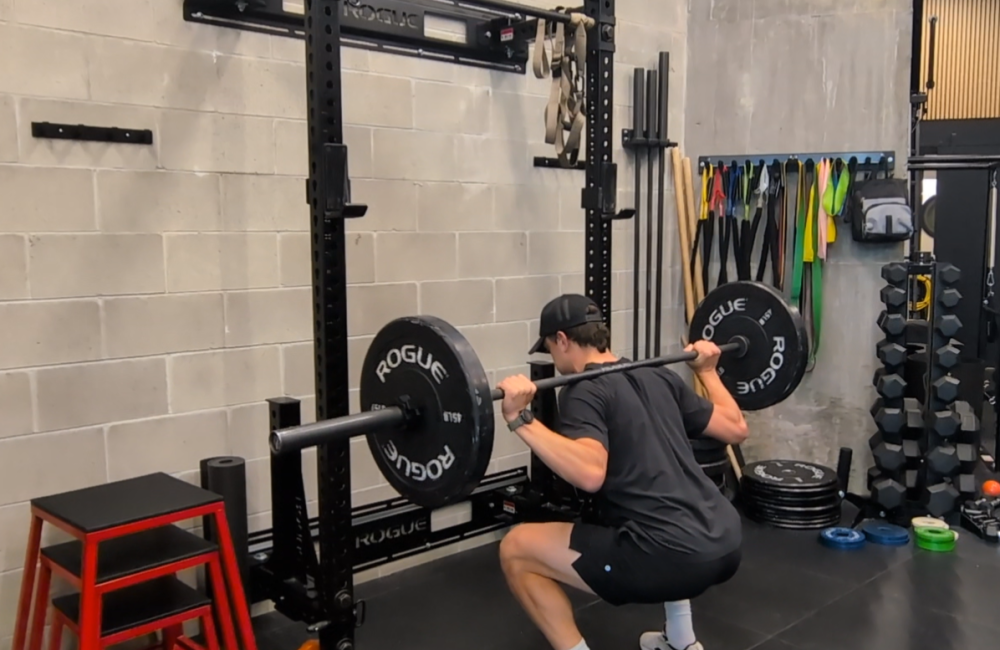
You cannot run fast if you do not have the raw materials to produce force. Research consistently shows that high-intensity strength training is foundational for developing speed. By utilizing squats, Olympic lifts, and targeted lower-body movements, we build the tissue capacity and muscular strength required to exert greater force with every foot contact. This is your engine.
Pillar 2: Plyometrics (The Springs)
Plyometrics bridge the gap between weight room strength and field speed. We use bounds, depth jumps, and horizontal plyometrics to train the stretch-shortening cycle (SSC). This teaches your muscles and tendons to act like stiff springs, absorbing and rapidly releasing energy so you spend less time on the ground and more time flying forward.
Pillar 3: Resisted Sprinting (The Accelerator)
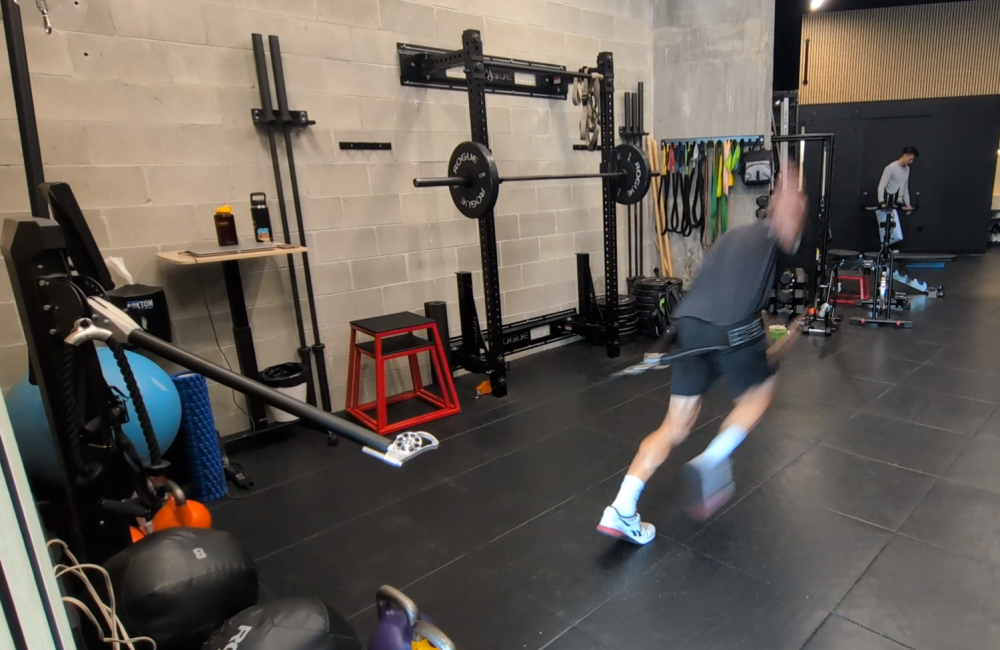
Recent data confirms that Resisted Sprint Training (RST) is the gold standard for improving initial acceleration, particularly the critical 0-10m burst used constantly in sports like soccer, ultimate, rugby, and field hockey. Free sprinting helps your top-end speed, but driving heavy sleds across the turf teaches your body the optimal forward trunk lean and horizontal force required for a 0-10m acceleration. Loading the athlete allows us to slow down and break down early acceleration mechanics, forcing proper body positions that directly enhance force delivery. Common drills to reinforce these acceleration mechanics include A-Series variations (marches, skips, runs), bounding drills, and resisted sprints.
Pillar 4: Max Velocity
Gym strength and plyometrics raise your capacity for speed, but they only build the engine. You can squat twice your bodyweight, but if you never run at 95-100% of your max velocity with complete recovery, your nervous system will never learn to move faster. Consistently exposing your central nervous system to maximum velocity running is the single most effective stimulus to continually push your top-end speed limits. To target max velocity mechanics, coaches utilize key drills such as dribbles, straight-leg shuffles/bounds, wicket runs, and assisted sprinting.
Unlocking top-end velocity requires combining these core training pillars into an integrated blueprint. Research confirms that combining resistance work with sprinting produces the most substantial gains in athletic output. At Lift Clinic, we carefully structure this periodization for our athletes. For instance, during the height of a competitive local season, we balance high-intensity, lower-volume weight room work with targeted speed drills so athletes stay sharp for game day without compromising recovery.
The Lift Clinic Difference: Vancouver Sports Performance
At Lift Clinic, we replace guesswork with objective performance tracking. Utilizing precise timing gate technology and force plates, our coaching staff provides immediate biomechanical feedback. This enables athletes to see how refined movement quality and structured recovery directly translate into elite field speed, allowing us to accurately monitor long-term athletic development over time.
Our coaches are university-degreed strength specialists (MSc, CSCS, Kinesiology) operating inside a sports physio facility. Our clinical integration isn’t just an occasional email update; it is shared floor space, unified client records, and real-time collaboration between clinicians and strength coaches. Working daily alongside Physiotherapy and Chiropractic professionals means we don’t guess when an athlete has nagging hamstring tightness or shoulder irritation. We modify loads and integrate clinical rehab directly into the training session so athletes keep developing without having to take time off.
We also know that accessibility and structured programming matter for Vancouver families. That is why we offer flexible delivery models tailored to Long-Term Athletic Development (LTAD):
- 1:1 Private Coaching: Ideal for specific rehab bridging, elite biomechanical profiling, maximum technical precision, and flexible scheduling.
- Small Group Drop-Ins: Capped at 3-4 athletes and grouped by development stages (Lift to Train, Lift to Compete, Lift to Win). This is the ideal middle ground for affordability and flexible scheduling without long-term lock-ins.
- Team Workshops: Low-barrier entries, like our Discover Your Strength Workshops, where our S&C coaches act as an extension of your club team’s staff.
The Rehab-to-Performance Bridge
Maximal velocity sprinting subjects tissues to forces up to five times your body weight. When sprint times decline or mechanical compensations surface due to underlying discomfort or tightness, forcing an athlete to push through high-intensity reps creates an environment for structural tissue tears. We carefully track workload demands and movement quality, pivoting training stress immediately whenever red flags arise.
Serving as a premier hub for athletic development, our Strength & Conditioning team shares clinical charting and floor space with in-house Physiotherapists, Chiropractors, and Registered Massage Therapists. When recovering from a hamstring strain or soft-tissue tear, our team guides you through a progressive continuum:
- Clinical Rehabilitation Phase: Partnering directly with an in-house Physiotherapist or Chiropractor to alleviate joint discomfort while restoring force production at long muscle lengths.
- Sub-Max Velocity Phase: Advancing onto the field for dynamic plyometrics, heavy resisted sprinting, and targeted acceleration mechanics.
- PR Phase: Reaching top-end velocity (flying 10m, 20m, and 30m sprints), high-stiffness ground contacts, and sport-specific acceleration/deceleration.
This integrated pathway bridges the gap between the treatment table and game-day speed.
Trust the Process, Trust the Science
Developing elite speed isn’t achieved by training until exhaustion; it is a refined skill cultivated through high-intent max-velocity effort. Whether you are an adult athlete seeking to reclaim game-day performance or a parent dedicated to building a resilient, high-performing youth athlete, structured strength and conditioning provides the necessary edge.
Ready To Take The Next Step?
Are You Recovering From An Injury Or Dealing With Nagging Pain?
Are You Healthy And Ready To Build Strength, Resilience, And Peak Speed?
