
By Travis Dodds, Physiotherapist and Founder of Lift Clinic
In my practice as a Vancouver Physiotherapist, I see it every single week. You have been dealing with a nagging pinch in your shoulder, or a noticeable restriction when you try to reach behind your back. Maybe you have lost power on your volleyball spike or your tennis serve. You do exactly what you are told: you grab a resistance band, you stretch the joint, and you try to push through it. But the tightness always comes back. You trained hard, did your dynamic warm-ups, and still ended up limping through your sport with a joint that refuses to rotate properly.
Here is what I have learned after years of treating these exact symptoms: directly stretching a tight shoulder is often the least effective way to fix it.
TL;DR: The Quick Breakdown
- Stop Forcing the Joint: The root cause of lost shoulder internal rotation often lives in your upper neck and rib cage, not the shoulder capsule itself.
- Don’t Normalize Pain: Treating shoulder tightness as an unavoidable part of your sport keeps you stuck in a cycle of useless band warm-ups that ignore the real problem.
- The Biomechanical Fix: A team approach using manual therapy for the neck and ribs, combined with positional core exercises, can unlock 10 to 25 degrees of shoulder mobility instantly in the clinic.
Ready to stop guessing and find your root cause? Book a comprehensive assessment with a Physio in Vancouver at Lift Clinic today.
The Myth of the "Normal" Bad Shoulder
A lot of active adults and athletes treat shoulder pain as something that is just a normal result of the sport they play. During my time working with high-level volleyball athletes, many of them would experience chronic shoulder pain and limited internal rotation. The culture around the sport was so accustomed to this that it was treated almost as an expectation.
Athletes would attempt to address the pain exclusively through dynamic warm-ups or routine movement sequences with resistance bands prior to practice and games. Notably, these exercises and stretching positions only address the local muscles of the shoulder joint. While they might drive some temporary blood flow, they completely ignore the root causes of the mechanical restriction.
I tell my clients this: repeatedly trying to fix the steering in your car when you just need to inflate a tire is exactly like repeatedly doing shoulder stretches and warm-ups when you actually need to gain trunk or neck mobility. You are trying to align the steering wheel, but the foundation is totally flat.
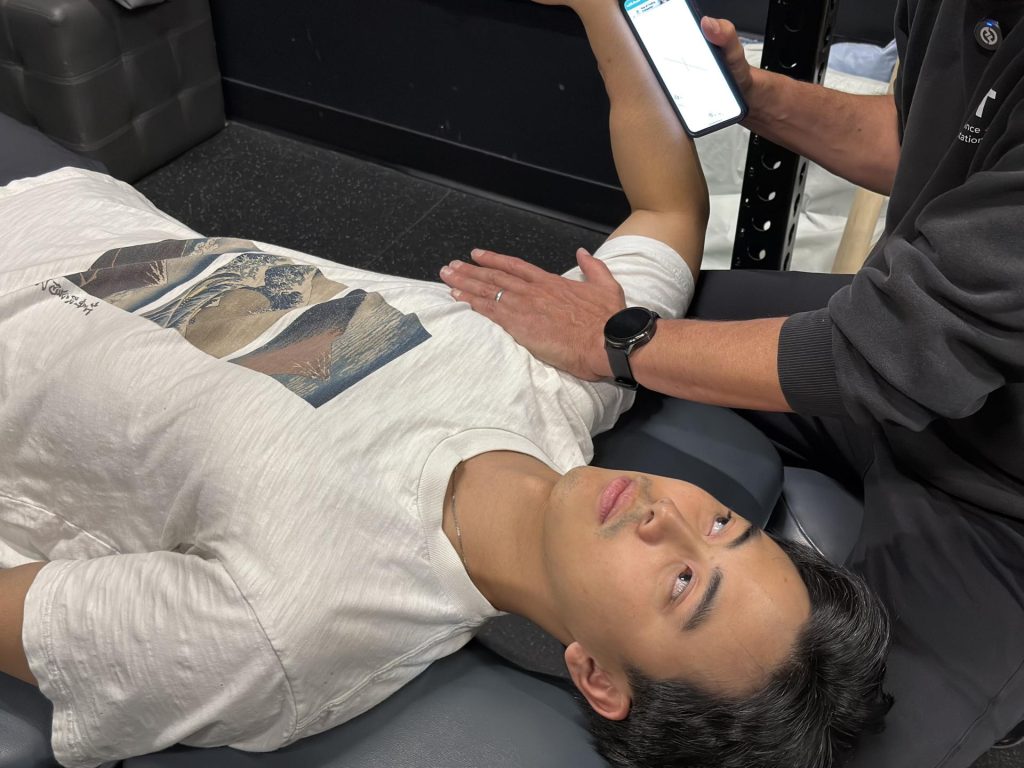
The Science vs. Our Clinical Reality
If you look at the last decade of sports medicine research regarding shoulder internal rotation deficits, the difference between the literature and our day-to-day clinical practice here at Lift Clinic is shocking.
Almost all of the research studies discuss direct treatment at the glenohumeral (shoulder) joint as the exclusive method for treating internal rotation deficits. Studies heavily emphasize isolation stretches like the sleeper stretch and the cross-body stretch. They look at the effectiveness of manually mobilizing the posterior capsule of the shoulder or using specific muscle energy techniques right at the joint.
However, in the clinic, the vast majority of our clients with this range of motion limitation—and the associated pain and weakness of the rotator cuff—demonstrate a limitation in their upper cervical range of motion or ribcage.
Specifically, we see major restrictions in C1-C2 rotation or occipital-atlantal (OA) joint flexion at the base of the skull.
Besides this upper cervical limitation, the next most common root cause for internal rotation deficit is posture and rib mobility. Typically, clients have difficulty creating expansion in the posterior rib cage. Most people will recognize this in the mirror as a “rib flare” of the lower ribs. When your ribs are flared and stuck, your shoulder blade has no stable foundation to rest on, causing the shoulder joint to jam up when you try to rotate it.
At Lift Clinic, we refuse to just give you a generic handout of sleeper stretches and send you on your way. We operate as a highly collaborative hub of interdisciplinary practitioners. Our team coordinates care so you get the exact stimulus you need to create lasting change.
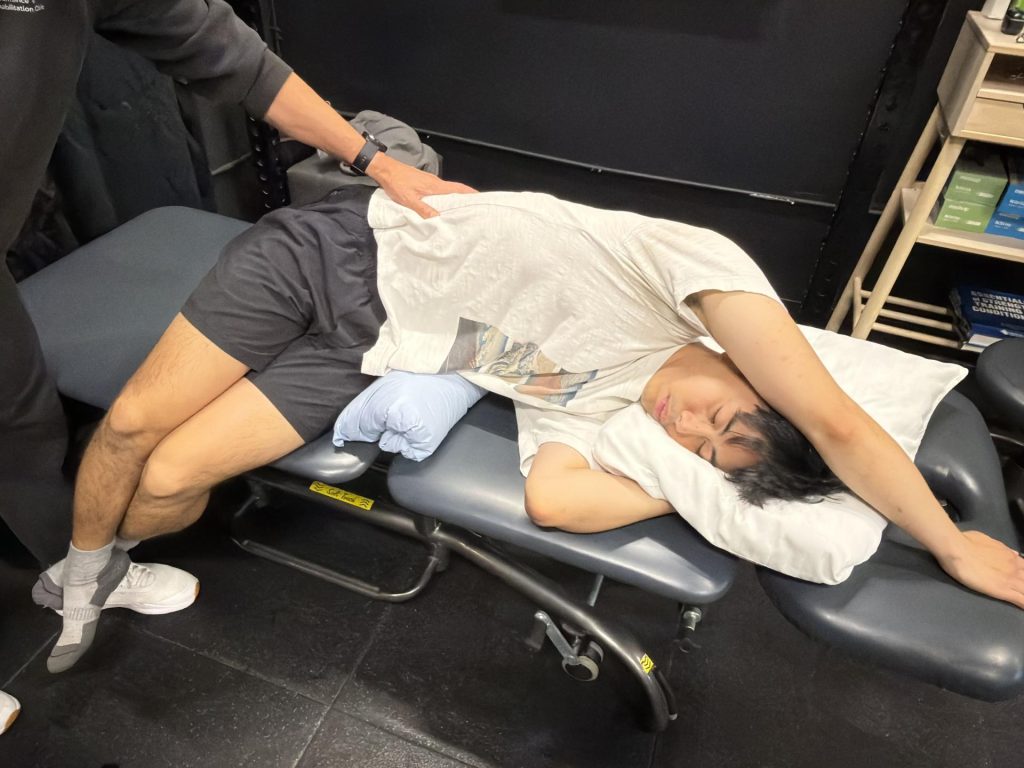
Depending on your detailed physical assessment, a Vancouver Chiropractor or Vancouver Massage Therapist on our team might use specific manual therapy techniques to unlock the upper cervical spine, the ribs, and the thoracic spine. Once that foundation is moving properly, we introduce specific positional exercises to correct the biomechanics of the trunk and pelvis. We use modalities like Clinical Pilates to teach you how to properly expand your posterior rib cage and manage your core pressure.
Only after we have addressed these root trunk and neck issues do we layer in direct shoulder stretching or targeted resistance band work, if it is still needed. By treating the neck and ribs first, we regularly see immediate improvements of 10 to 25 degrees of measured shoulder internal rotation right here in the clinic—without ever aggressively yanking on the shoulder joint itself.
Once the mobility is unlocked, our Vancouver Personal Trainers and strength coaches step in. We do not just build generic strength; we focus on sport-specific tissue capacity and resilience. Whether you are doing Team Training or 1-on-1 coaching, we load that newly acquired range of motion so your nervous system trusts it and keeps it permanently.
Reclaim Your Mobility
Do not let anyone tell you that losing your shoulder rotation is just a normal part of aging or playing your favorite sport. The restriction may be a signal that your body is compensating for a lack of mobility somewhere else in the chain. Fix the flat tire, and your steering will correct itself.
Ready To Take The Next Step?
If you are currently in pain or dealing with an injury: Book your initial Physiotherapy or Chiropractic assessment today to find the root cause of your shoulder restriction.
If you are pain-free but seeking peak performance and injury prevention: Book a Strength & Conditioning consult to build resilience and sport-specific tissue capacity
